CITY REBOOT: Planung nach der Pandemie und das neue europäische Bauhaus - eBook
ECTP-CEU Young Planners Workshop 2021 Das Thema stützt sich auf die neue europäische Bauhaus-Initiative, die die Tür zu einem ganzheitlicheren Ansatz öffnen soll.
EUROPÄISCHES KLIMARECHT
Das Europäische Parlament nahm in seiner Plenarsitzung am 24. Juni die vorläufige Einigung mit dem Rat an, der sie am 28. Juni förmlich angenommen hatte.
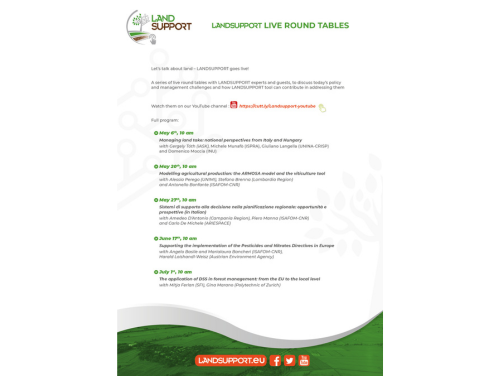
LANDSUPPORT Live Rundtischgespräche (06/05 - 20/05 - 27/05 - 17/06 - 01/07/2021)
LANDSUPPORT war sehr aktiv und hat, wie in den Projektzielen angegeben, Instrumente entwickelt. Jetzt ist es an der Zeit, über sie zu sprechen! #LetsTalkAboutLand - LANDSUPPORT
Implementing ECTP-CEU’s Re-START Europe Declaration : A joint project LINCOLN Institute – ECTP-CEU
Call for European case studies Update on the call to members of ECTP-CEU for case studies of Post-COVID recovery plans building on the Re-Start Europe
CITY REBOOT : Post-Pandemic Planning and the New European Bauhaus
ECTP Young Planners 2021 This year’s topic builds on the initiative launched by Ursula von der Leyen (President of the European Commission) called New European
ECTP-CEU RE-START EUROPE Manifesto : Declaration for an inclusive and just post-Covid future for all communities.
ECTP-CEU (European Council of Spatial Planners – Conseil Européen des Urbanistes) felt the need to reflect on the effects of the current crisis on our future living and working environment.
Diese Erklärung zielt darauf ab, die kreative Kraft und das technische Fachwissen von Raumplanern zur Bewältigung der durch die Covid-19-Pandemie verursachten sozialen und wirtschaftlichen Krise zu nutzen. Sie hat die Ungleichheiten verstärkt und die Schwächen der Gesellschaften in ganz Europa offengelegt, was sich kurzfristig auswirkt, aber das mittel- und langfristige Wohlergehen der Gemeinschaften in ganz Europa bedroht.
Besides a preamble and an annex with mega-trends, this Declaration sets out the principles that must be applied in the Recovery plans for Europe.
The New Leipzig Charter
The New Leipzig Charter
The New Leipzig Charter- The transformative power of cities for the common good was adopted at the Informal Ministerial Meetings organised on 30 November 2020 under German Presidency.
The New Leipzig Charter provides a key policy framework document for sustainable urban development in Europe. The Charter highlights that cities need to establish integrated and sustainable urban development strategies and ensure their implementation for the city as a whole, from its functional areas to its neighbourhoods. The document is strongly aligned with the Cohesion Policy and its framework for sustainable urban development. Member States agreed to implement the Charter in their national or regional urban policies.
The common principles are useful references for programming Cohesion Policy (Integrated territorial development and sustainable urban development). The Charter would allow Member States to develop national urban policies of high quality.
The New Leipzig Charter is also accompanied by an Implementing document which intends to guide the next phase of the Urban Agenda for the EU according to renewed parameters.
The New European Bauhaus
Making the Renovation Wave a Cultural Project
The ECTP-CEU, in collaboration with the representative European organisations of architects, spatial planners, landscape architects, interior architects, engineers, designers, artists, educators and researchers of the built environment, welcomes the New European Bauhaus initiative put forward by the President of the European Commission as part of the Renovation Wave strategy.
New European Bauhaus : Commission Launches design phase
The Commission launched on 18 January 2021 the design phase of the New European Bauhaus initiative, announced by President von der Leyen in her 2020 State of the Union address.
https://ec.europa.eu/commission/presscorner/detail/en/ip_21_111
La Commission a lancé le 18 janvier 2021, la phase de conception de l’initiative relative au nouveau Bauhaus européen, annoncée par la présidente von der Leyen dans son discours sur l’état de l’Union de 2020.
https://ec.europa.eu/commission/presscorner/detail/fr/ip_21_111
Green, Smart and Affordable Mobility
European Commission – Press release
A fundamental transport transformation: Commission presents its plan for green, smart and affordable mobility
Brussels, 9 December 2020
The European Commission presented today its ‘Sustainable and Smart Mobility Strategy’ together with an Action Plan of 82 initiatives that will guide our work for the next four years. This strategy lays the foundation for how the EU transport system can achieve its green and digital transformation and become more resilient to future crises. As outlined in the European Green Deal, the result will be a 90% cut in emissions by 2050, delivered by a smart, competitive, safe, accessible and affordable transport system.
Frans Timmermans, Executive Vice-President for the European Green Deal, said: “To reach our climate targets, emissions from the transport sector must get on a clear downward trend. Today’s strategy will shift the way people and goods move across Europe and make it easy to combine different modes of transport in a single journey. We’ve set ambitious targets for the entire transport system to ensure a sustainable, smart, and resilient return from the COVID-19 crisis.”
Commissioner for Transport Adina Vălean said: “As the backbone that connects European citizens and business, transport matters to us all. Digital technologies have the potential to revolutionise the way we move, making our mobility smarter, more efficient, and also greener. We need to provide businesses a stable framework for the green investments they will need to make over the coming decades. Through the implementation of this strategy, we will create a more efficient and resilient transport system, which is on a firm pathway to reduce emissions in line with our European Green Deal goals.”
NEW EUROPEAN BAUHAUS
The ECTP-CEU, in collaboration with the representative European organisations of architects, spatial planners, landscape architects, interior architects, engineers, designers, artists, educators and researchers of the built environment, welcomes the New European Bauhaus initiative put forward by the President of the European Commission as part of the Renovation Wave strategy.
ECTP-CEU, en collaboration avec les organisations européennes représentatives d’architectes, d’aménageurs spatiaux, d’architectes paysagistes, d’architectes d’intérieur, d’ingénieurs, de designers, d’artistes, d’éducateurs et de chercheurs de l’environnement bâti, se félicite de l’initiative Nouveau Bauhaus Européen présentée par la Présidente de la Commission Européenne dans le cadre de la stratégie ” Vague de Rénovations”.
RENOVATION WAVE STRATEGY
Renovation Wave: doubling the renovation rate to cut emissions, boost recovery and reduce energy poverty
The European Commission has published today its Renovation Wave Strategy to improve the energy performance of buildings. The Commission aims to at least double renovation rates in the next ten years and make sure renovations lead to higher energy and resource efficiency. This will enhance the quality of life for people living in and using the buildings, reduce Europe’s greenhouse gas emissions, foster digitalisation and improve the reuse and recycling of materials. By 2030, 35 million buildings could be renovated and up to 160,000 additional green jobs created in the construction sector.
Buildings are responsible for about 40% of the EU’s energy consumption, and 36% of greenhouse gas emissions from energy (*). But only 1% of buildings undergo energy efficient renovation every year, so effective action is crucial to making Europe climate-neutral by 2050. With nearly 34 million Europeans unable to afford keeping their homes heated, public policies to promote energy efficient renovation are also a response to energy poverty, support the health and wellbeing of people and help reduce their energy bills. The Commission has also published today a Recommendation for Member States on tackling energy poverty.
Executive Vice-President for the European Green Deal, Frans Timmermans said: “We want everyone in Europe to have a home they can light, heat, or cool without breaking the bank or breaking the planet. The Renovation Wave will improve the places where we work, live and study, while reducing our impact on the environment and providing jobs for thousands of Europeans. We need better buildings if we want to build back better.”
RE-START – EUROPE Manifesto
ECTP-CEU approved during its last General Assembly the “RE-START-EUROPE” Declaration for an inclusive and just post-Covid future for all communities.This Declaration – which was presented
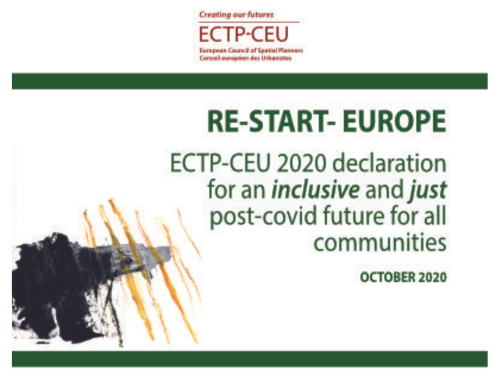
RE-START – EUROPE Manifesto
ECTP-CEU approved during its last General Assembly the “RE-START-EUROPE” Declaration for an inclusive and just post-Covid future for all communities. This Declaration – which was
2020 – Young Planners Workshop “Heritage in a Planning Context”
About 2020 Workshop In the last twenty years, the cultural heritage role in urban management has evolved from institutionalising conservation efforts to placing heritage at
About the ECTP-CEU European Urban and Regional Planning Awards
The European Urban and Regional Planning Awards, organized every two years by the ECTP-CEU since 1990, provide a common framework for planning practice and rewards
Planners for Climate Action communique during the UN high level political forum 2019
2019 High-level political forum on sustainable development Planners call for better integrating urban planning practices in strategies to achieve SDG 13 and effectively combat climate
Conclusions of the SOPHIE project are available
Over the past few years, SOPHIE has accumulated evidence regarding the influence of social and economic policies on the health of the population and on